High Probability Complexity Bounds of Trust-Region Stochastic Sequential Quadratic Programming with Heavy-Tailed Noise
Abstract
In this paper, we consider nonlinear optimization problems with a stochastic objective and deterministic equality constraints. We propose a Trust-Region Stochastic Sequential Quadratic Programming (TR-SSQP) method and establish its high-probability iteration complexity bounds for identifying first- and second-order $\epsilon$-stationary points. In our algorithm, we assume that exact objective values, gradients, and Hessians are not directly accessible but can be estimated via zeroth-, first-, and secondorder probabilistic oracles. Compared to existing complexity studies of SSQP methods that rely on a zeroth-order oracle with sub-exponential tail noise (i.e., light-tailed) and focus mostly on first-order stationarity, our analysis accommodates irreducible and heavy-tailed noise in the zeroth-order oracle and significantly extends the analysis to second-order stationarity. We show that under heavy-tailed noise conditions, our SSQP method achieves the same high-probability first-order iteration complexity bounds as in the light-tailed noise setting, while further exhibiting promising second-order iteration complexity bounds. Specifically, the method identifies a first-order $\epsilon$-stationary point in $O(\epsilon^{-2})$ iterations and a second-order $\epsilon$-stationary point in $O(\epsilon^{-3})$ iterations with high probability, provided that $\epsilon$ is lower bounded by a constant determined by the irreducible noise level in estimation. We validate our theoretical findings and evaluate the practical performance of our method on CUTEst benchmark test set.

Yuchen Fang
MS in Computational and Applied Math (2021-2023)
Yuchen Fang is a PhD student in the mathematics department at UC Berkeley. He was a master student in the Computational and Applied Math program at UChicago, where he worked with Mladen Kolar and Sen Na on stochastic nonlinear optimization. His research interests include numerical linear algebra, high-dimensional statistics, statistical learning, and mathematical finance.
Sen Na
Assistant Professor in ISyE
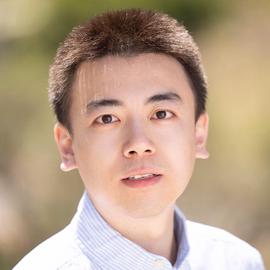
Sen Na is an Assistant Professor in the School of Industrial and Systems Engineering at Georgia Tech. Prior to joining ISyE, he was a postdoctoral researcher in the statistics department and ICSI at UC Berkeley. His research interests broadly lie in the mathematical foundations of data science, with topics including high-dimensional statistics, graphical models, semiparametric models, optimal control, and large-scale and stochastic nonlinear optimization. He is also interested in applying machine learning methods to problems in biology, neuroscience, and engineering.