Abstract
In this paper, we propose a trust-region interior-point stochastic sequential quadratic programming (TR-IP-SSQP) method for solving optimization problems with a stochastic objective and deterministic nonlinear equality and inequality constraints. In this setting, exact evaluations of the objective function and its gradient are unavailable, but their stochastic estimates can be constructed. In particular, at each iteration our method builds stochastic oracles, which estimate the objective value and gradient to satisfy proper adaptive accuracy conditions with a fixed probability. To handle inequality constraints, we adopt an interior-point method (IPM), in which the barrier parameter follows a prescribed decaying sequence. Under standard assumptions, we establish global almost-sure convergence of the proposed method to first-order stationary points. We implement the method on a subset of problems from the CUTEst test set, as well as on logistic regression problems, to demonstrate its practical performance.

Yuchen Fang
MS in Computational and Applied Math (2021-2023)
Yuchen Fang is a PhD student in the mathematics department at UC Berkeley. He was a master student in the Computational and Applied Math program at UChicago, where he worked with Mladen Kolar and Sen Na on stochastic nonlinear optimization. His research interests include numerical linear algebra, high-dimensional statistics, statistical learning, and mathematical finance.
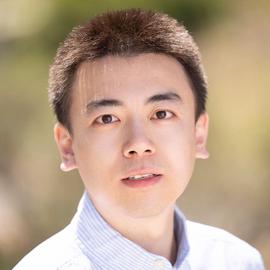
Sen Na
Assistant Professor in ISyE
Sen Na is an Assistant Professor in the School of Industrial and Systems Engineering at Georgia Tech. Prior to joining ISyE, he was a postdoctoral researcher in the statistics department and ICSI at UC Berkeley. His research interests broadly lie in the mathematical foundations of data science, with topics including high-dimensional statistics, graphical models, semiparametric models, optimal control, and large-scale and stochastic nonlinear optimization. He is also interested in applying machine learning methods to problems in biology, neuroscience, and engineering.