Statistical Inference of Constrained Stochastic Optimization via Sketched Sequential Quadratic Programming
Abstract
We consider online statistical inference of constrained stochastic nonlinear optimization problems. We apply the Stochastic Sequential Quadratic Programming (StoSQP) method to solve these problems, which can be regarded as applying second-order Newton’s method to the Karush-Kuhn-Tucker (KKT) conditions. In each iteration, the StoSQP method computes the Newton direction by solving a quadratic program, and then selects a proper adaptive stepsize $\bar{\alpha}_t$ to update the primal-dual iterate. To reduce dominant computational cost of the method, we inexactly solve the quadratic program in each iteration by employing an iterative sketching solver. Notably, the approximation error of the sketching solver need not vanish as iterations proceed, meaning that the per-iteration computational cost does not blow up. For the above StoSQP method, we show that under mild assumptions, the rescaled primal-dual sequence $1/\sqrt{\bar{\alpha}_t}\cdot (x_t−x^{\star},\lambda_t-\lambda^\star)$ converges to a mean-zero Gaussian distribution with a nontrivial covariance matrix depending on the underlying sketching distribution. To perform inference in practice, we also analyze a plug-in covariance matrix estimator. We illustrate the asymptotic normality result of the method both on benchmark nonlinear problems in CUTEst test set and on linearly/nonlinearly constrained regression problems.
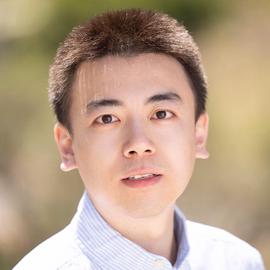
Sen Na
Assistant Professor in ISyE
Sen Na is an Assistant Professor in the School of Industrial and Systems Engineering at Georgia Tech. Prior to joining ISyE, he was a postdoctoral researcher in the statistics department and ICSI at UC Berkeley. His research interests broadly lie in the mathematical foundations of data science, with topics including high-dimensional statistics, graphical models, semiparametric models, optimal control, and large-scale and stochastic nonlinear optimization. He is also interested in applying machine learning methods to problems in biology, neuroscience, and engineering.

Michael W. Mahoney
Professor in Statistics and ICSI, Amazon Scholar
Michael Mahoney is a Professor in the Statistics department and ICSI at UC Berkeley. He is also the director of the NSF/TRIPODS-funded Foundations of Data Analysis (FODA) Institute at UC Berkeley. He works on the algorithmic and statistical aspects of modern large-scale data analysis. Much of his recent research has focused on large-scale machine learning, including randomized matrix algorithms and randomized numerical linear algebra.